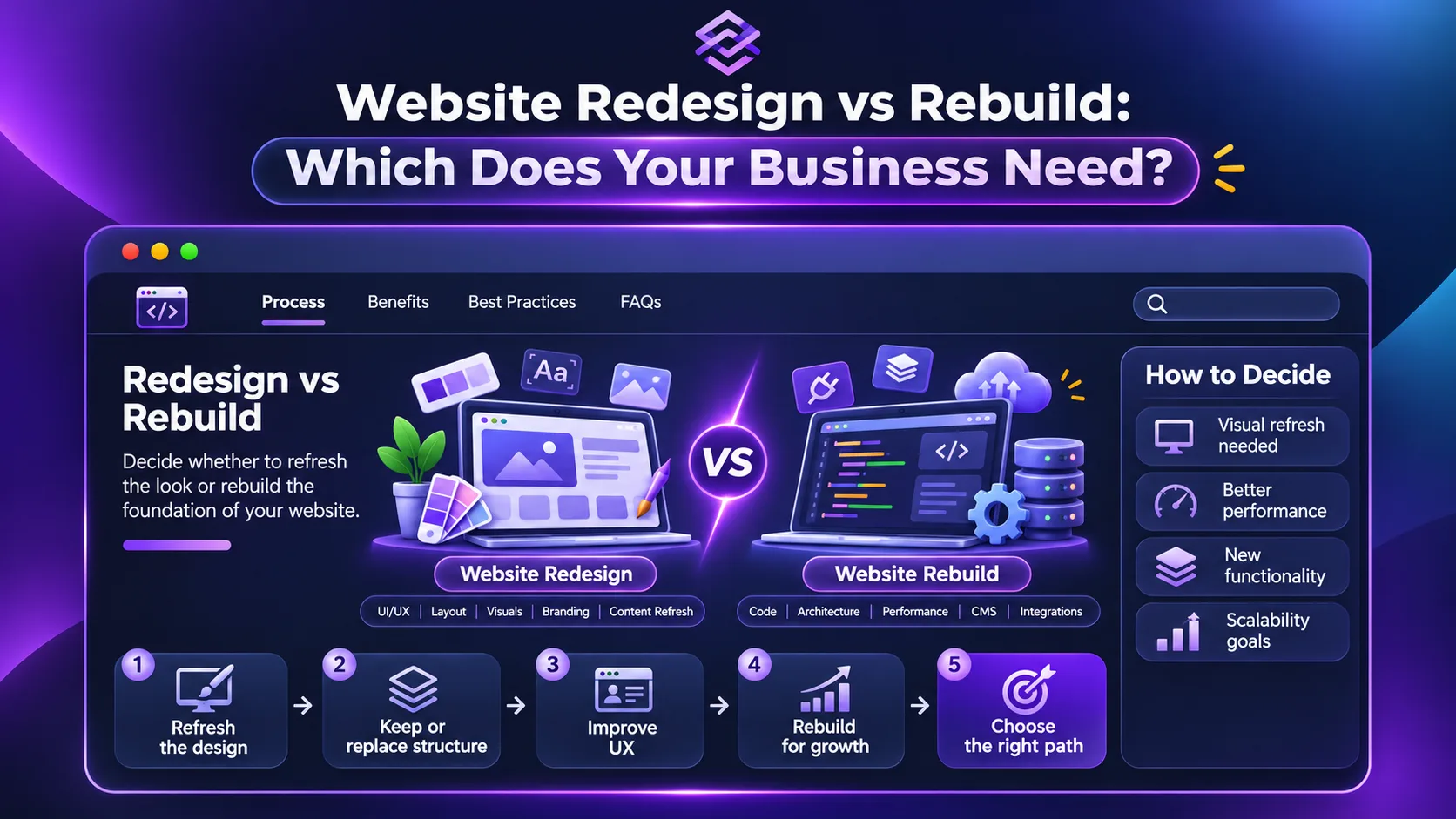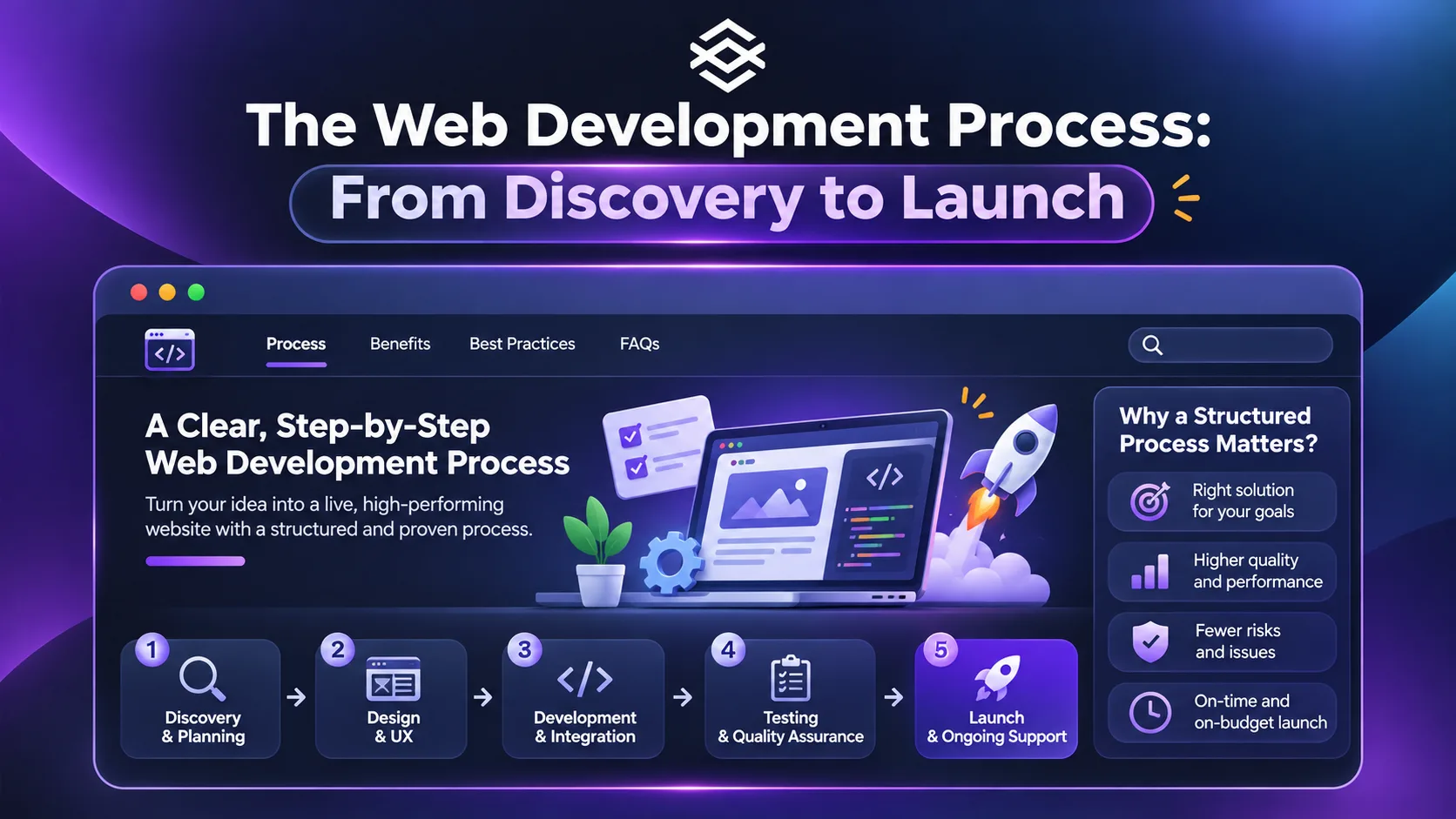
A good website should not move directly from an idea to coding.
A structured web development process turns business requirements into clear scope, design, functionality, testing, and a controlled launch.
The exact stages vary by project, but the goal is the same: make important decisions early, reduce unnecessary rework, and know what should happen before the website goes live.
Quick Answer:
A typical web development process includes discovery, project scope, UX/UI design, development, content preparation, testing, launch, and post-launch support. These stages can overlap, but each should produce a clear outcome before the project moves too far forward.
Web Development Process: The 8 Main Stages
Stage | Main Question | Expected Output |
|---|---|---|
1. Discovery | What are we building and why? | Goals and requirements |
2. Scope | What exactly is included? | Pages, features, responsibilities |
3. UX/UI | How should users move through it? | Wireframes and approved designs |
4. Development | How will it work technically? | Working frontend and backend |
5. Content | What will users actually read and see? | Approved real content |
6. Testing | Does everything work as expected? | Tested and reviewed website |
7. Launch | Is it ready for real users? | Live production website |
8. Support | What happens after launch? | Maintenance and improvement plan |
If you are still choosing who should manage this process, our guide to choosing the best web development company in Egypt covers what to evaluate before hiring.
Stage 1: Discovery Starts the Web Development Process
Discovery answers the most important question:
What are we actually building, and why?
Before discussing colors, frameworks, or animations, the development team should understand:
Business goals
Target users
Main website actions
Existing problems
Required functionality
Languages
Integrations
Competitors
Future requirements
For a small company website, discovery may require only a few focused conversations.
For a custom web platform, it can involve workflows, user roles, data requirements, integrations, and several stakeholders.
Skipping discovery often creates a predictable problem:
The website gets built according to the original request, but the original request did not fully describe the actual business need.
Stage 2: Turn Requirements Into a Clear Project Scope
The next stage of the web development process defines exactly what will be built.
A good scope removes ambiguity before development begins.
Area | What Should Be Defined |
|---|---|
Pages | Home, About, Services, Contact, etc. |
Features | Forms, booking, search, login |
Languages | English, Arabic, or others |
Integrations | CRM, payments, APIs |
Design | Template, customized, or custom |
Content | Who provides or creates it |
SEO | Technical foundations or broader SEO scope |
Testing | Devices, browsers, functionality |
Launch | Hosting, migration, redirects |
Support | Duration and responsibilities |
A clear scope also makes quotations and timelines easier to compare.
If you are preparing requirements before contacting developers, how to write a website development brief will show what information should be ready before requesting proposals.
Stage 3: UX and UI Design the Experience
Once the project scope is stable enough, the team can plan how users will move through the website.
UX focuses on structure and usability.
UI focuses on the visual interface.
A typical flow may look like:
Sitemap → User Journey → Wireframes → Visual Design → Responsive Design
The objective is not simply to create attractive pages.
A visitor should understand:
Where they are
What the page offers
What they should do next
How to reach important information
For a service business, the journey might be:
Service → Evidence → Decision → Contact
For an eCommerce website:
Category → Product → Cart → Checkout → Payment
These journeys should be considered before development locks the interface into code.
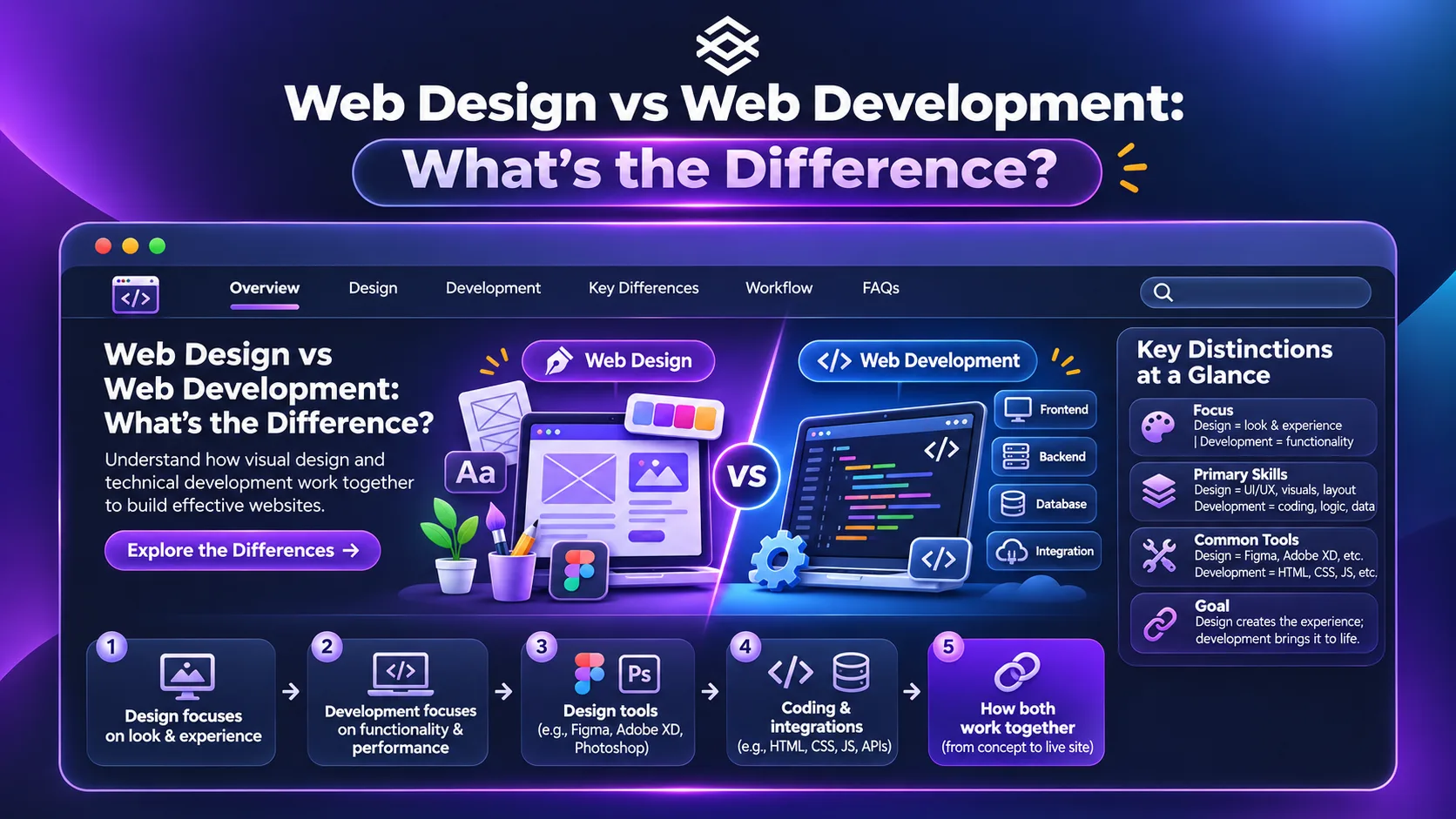
If the distinction between these responsibilities is unclear, web design vs web development explains where design ends and development begins.
Stage 4: Website Development Begins
Development turns approved requirements and designs into a functioning website or application.
The work usually includes frontend development, backend development, or both.
Frontend Development
The frontend includes what users see and interact with:
Layouts
Navigation
Buttons
Forms
Content sections
Interactive elements
Responsive behavior
Backend Development
The backend handles data and business logic such as:
User accounts
Databases
Permissions
Payments
APIs
Booking logic
Dashboards
Integrations
Not every website needs a complex backend.
The technical approach should match the requirements rather than adding complexity simply because it is possible.
If the project requirements could be handled by an existing solution, our custom web development vs templates comparison helps clarify when customization is actually justified.
Stage 5: Content Should Develop Alongside the Website
Content is one of the easiest ways for a web development process to fall behind schedule.
The development team may be ready while the project is still waiting for:
Final page copy
Images
Product information
Team profiles
Translations
Legal pages
Downloads
Case studies
Content should therefore begin early rather than being treated as the last task before launch.
Real content can also expose design problems.
A section that works perfectly with placeholder text may break when the real service description is twice as long.
Content Readiness Checklist
Before final testing, confirm:
Page copy is approved
Headings are correct
Images are optimized
Contact details are accurate
Calls to action lead to the right destination
Products or services are complete
Language versions are ready where required
SEO Should Run Through the Web Development Process
Technical SEO should not be treated as a separate final-stage task.
Some SEO decisions begin during planning, others during development, and others immediately before launch.
Important areas include:
URL structure
Page hierarchy
Crawlability
Heading structure
Internal linking
Mobile usability
Performance
Metadata fields
Redirects
XML sitemap
Structured data where relevant
For example, redirect planning matters most during a redesign or migration, while site architecture should be considered much earlier.
The goal is not to turn developers into an entire SEO team.
It is to avoid launching a website with technical problems that could have been prevented during development.
Our SEO-friendly web development guide will cover these foundations separately.
Stage 6: Test Before You Launch
Testing should happen during development, but the completed website still needs a controlled pre-launch review.
Test Area | What to Check |
|---|---|
Responsive | Mobile, tablet, desktop |
Browsers | Important browsers used by customers |
Forms | Validation, submission, notifications |
Links | Broken or incorrect destinations |
Accounts | Login, logout, permissions |
Integrations | Data moves correctly |
Payments | Successful and failed flows |
Content | Missing text or images |
Performance | Major loading problems |
Errors | Useful behavior when something fails |
Testing depth should match project risk.
A five-page business website does not need the same QA process as a platform processing customer payments.
The important point is that testing is planned rather than squeezed into whatever time remains before launch.
Stage 7: Launch the Website Carefully
Launch moves the approved website into its production environment.
Depending on the project, that may involve:
Production Hosting → Database → Domain → SSL → Redirects → Analytics → Sitemap → Final Checks
Existing websites require particular care.
Changing URLs without proper redirects, for example, can break links and unnecessarily disrupt organic visibility.
Launch Checklist
Before going live, confirm:
Domain configuration is correct
SSL works
Backups exist
Forms reach the correct people
Analytics is recording data
Important redirects work
Search engines can access intended pages
Administrator access has been transferred
A rollback option exists if something critical fails
A controlled launch should have an owner and a checklist.
It should not be an improvised final step.
Stage 8: Define Support After Launch
Launching the website does not mean development needs disappear forever.
Businesses may later need:
Bug fixes
Security updates
Backups
Performance monitoring
Content changes
Integration updates
New pages
Additional functionality
The important distinction is between:
Bug → Maintenance → Improvement → New Feature
These are not always the same type of work and may not be covered by the same agreement.
Our website maintenance after launch guide will explain those responsibilities in more detail.
Web Development Process Red Flags
Knowing the correct stages is useful.
Knowing when the process is going wrong is often more useful.
Stage | Red Flag |
|---|---|
Discovery | The first conversation focuses on colors before business goals |
Scope | Features are discussed but never documented |
UX/UI | Development starts before key layouts are approved |
Development | You cannot review progress on a staging environment |
Content | Real content is left until the final week |
Testing | “Testing” means one person checked the website once |
Launch | There is no backup, redirect, analytics, or rollback plan |
Support | Nobody can explain what happens after launch |
One red flag does not automatically mean a bad project.
Repeated uncertainty across several stages is more concerning.
A strong web development process should make responsibilities and decisions clearer as the project progresses—not more confusing.
How Long Does the Web Development Process Take?
There is no reliable universal timeline.
The duration depends on:
Number of pages
Custom design requirements
Functionality
Integrations
Content readiness
Number of stakeholders
Feedback speed
Testing requirements
A straightforward company website can move much faster than an eCommerce platform or custom application.
Instead of asking only:
“How many weeks will this take?”
also ask:
“Which stages determine that timeline?”
Our how long does it take to build a website guide will compare timelines by project type.
Where Egensolve Fits in the Web Development Process
Egensolve works across the development lifecycle for business websites and custom web platforms, including requirements, UX/UI, frontend and backend development, integrations, testing, and deployment.
You can review our web development services to see how that approach can apply to a real project.
FAQs About the Web Development Process
What are the main stages of the web development process?
The main stages are discovery, scope, UX/UI design, development, content preparation, testing, launch, and post-launch support.
What comes first in web development?
Discovery normally comes first. The project team needs to understand the business goals, users, requirements, and constraints before making major design or technical decisions.
How long does the web development process take?
It depends on scope. A straightforward website may take several weeks, while custom applications and integration-heavy projects can require considerably longer.
When should website content be prepared?
Content should begin early and develop alongside design and development. Leaving it until the end can delay launch and expose layout problems late in the project.
Does SEO happen during the web development process?
Yes, technical SEO considerations should run through several stages of the process. Site structure, URLs, mobile usability, performance, crawlability, internal links, and redirects should not all be left until after launch.
A Good Web Development Process Reduces Uncertainty
The web development process does not exist to make a website project more complicated.
It exists to reduce uncertainty.
Discovery defines the problem.
Scope defines the work.
Design defines the experience.
Development builds the product.
Content fills it with real information.
Testing checks it.
Launch puts it in front of users.
Support keeps responsibilities clear afterward.
When those stages are understood, important decisions happen earlier—when changes are usually easier to manage.
If you already have requirements for a website or web platform and want to define the right next step, you can discuss your project with Egensolve.