Most websites do not have one standard development timeline.
A simple landing page may take days or a couple of weeks. A business website may take several weeks. A custom platform with integrations, user accounts, and complex functionality can take months.
So, how long does it take to build a website?
The useful answer depends on what is being built—and how quickly decisions, content, and feedback move through the project.
Quick Answer:
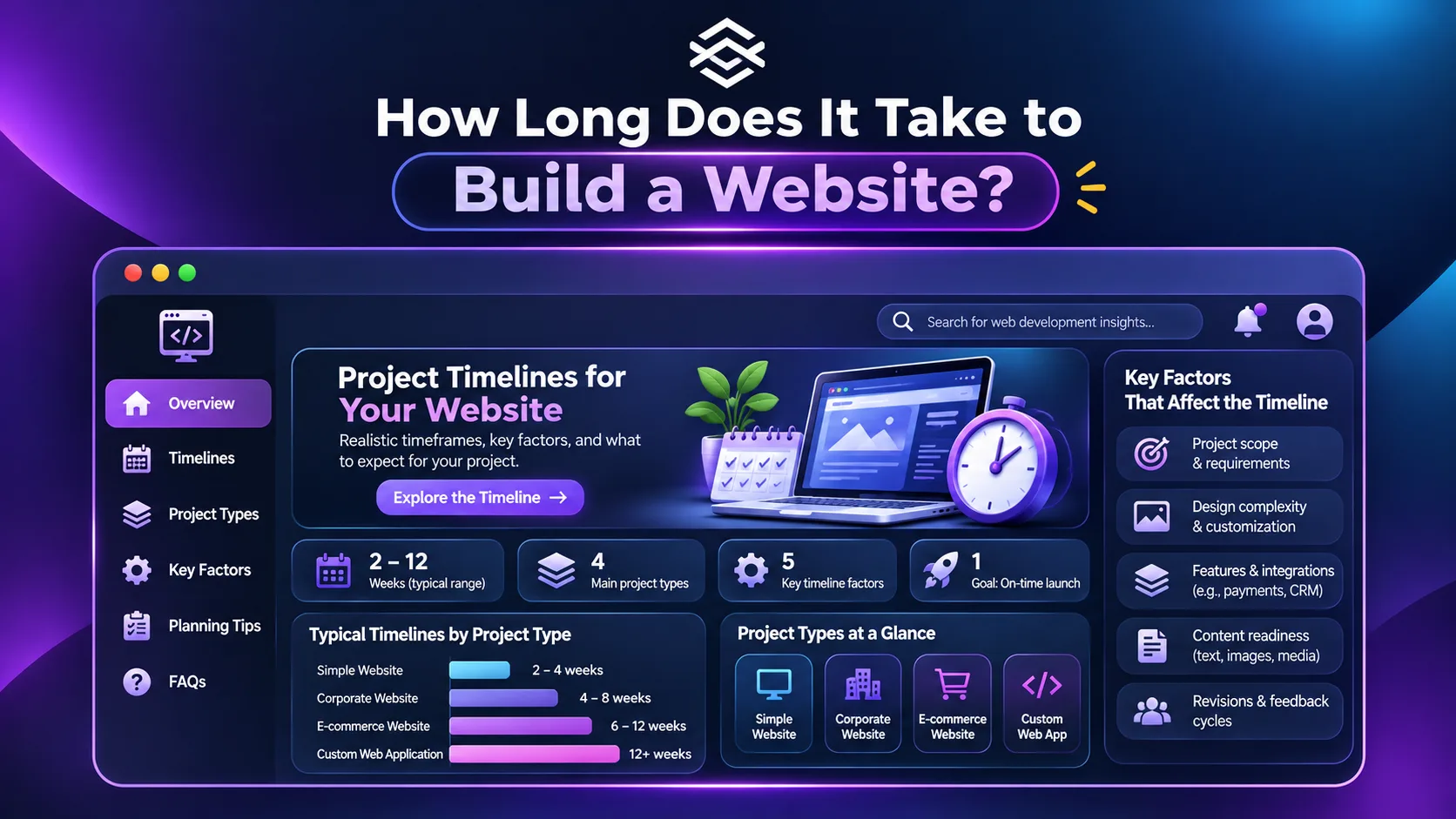
A straightforward business website may take around 3–6 weeks, while larger corporate websites can require 6–12 weeks or more. eCommerce and custom platforms often take longer. Scope, content, design, integrations, testing, and feedback speed usually affect the website development timeline more than page count alone.
If you are still choosing who will build the project, our guide to choosing the best web development company in Egypt explains what to evaluate before comparing timelines and proposals.
How Long Does It Take to Build a Website by Type?
These are planning ranges rather than fixed promises.
Website Type | Typical Planning Range | What Usually Adds Time |
|---|---|---|
Landing page | 1–2 weeks | Custom design, copy, integrations |
Small business website | 3–6 weeks | Content, revisions, CMS setup |
Corporate website | 6–12+ weeks | More templates, stakeholders, content |
Bilingual website | 4–10+ weeks | Arabic/English content and QA |
eCommerce website | 6–16+ weeks | Products, payments, shipping, accounts |
Custom web platform | 2–6+ months | Roles, workflows, APIs, integrations |
The ranges overlap because two websites with the same number of pages can require completely different amounts of work.
A five-page website with a booking system and CRM integration may take longer than a 20-page informational website.
Website Build Time vs Calendar Time
This distinction is often overlooked.
A development team may need 25 working days to complete a project.
That does not necessarily mean the website launches 25 days after kickoff.
A project also contains waiting time.
Development Time
Time spent actively working on:
Planning
Design
Development
Integrations
Content implementation
Testing
Deployment
Waiting Time
Time spent waiting for:
Content
Images
Feedback
Approvals
Credentials
Payment gateway approval
Third-party access
Internal decisions
This means a six-week build can easily become a ten-week calendar project without the development itself becoming more complicated.
That is why a useful website timeline should show dependencies, not just a launch date.
What Happens During a Website Development Timeline?
Most projects move through several connected stages:
Discovery → Scope → UX/UI → Development → Content → Testing → Launch
Each stage affects the next one.
For example, development may be technically fast, but it cannot finish correctly if major layouts are still changing.
Likewise, testing cannot be completed properly while important functionality is still being added.
Our web development process from discovery to launch explains what should happen at each stage.
What Determines How Long It Takes to Build a Website?
Several factors have much more impact than others.
1. Project Scope
The biggest factor is what the website needs to do.
Compare these two projects:
Website A
8 informational pages
Contact form
Blog
CMS
Website B
8 pages
Customer accounts
Booking system
Online payments
CRM integration
Automated notifications
Both have eight pages.
Their development timelines should not be remotely similar.
Functionality matters more than page count alone.
2. Template vs Custom Development
Starting with an existing platform or template can reduce the amount of design and development required.
Custom development usually requires more planning because the solution is being shaped around specific requirements.
That does not mean custom development must always take months.
It means fewer decisions have already been made for you.
If speed is one of your main priorities, understanding custom web development vs templates can help you decide which trade-offs are reasonable.
3. Content Readiness
Content is one of the easiest ways for a website timeline to slip.
The development may be ready while everybody waits for:
Homepage copy
Service descriptions
Product information
Staff profiles
Images
Case studies
Arabic translations
Legal content
Starting content on launch week is usually too late.
Real content should move alongside design and development whenever possible.
4. Feedback and Approvals
Imagine a project has three review stages.
If feedback arrives within two days at each stage, progress continues quickly.
If each approval takes ten days, weeks are added without a single additional feature being developed.
The problem becomes worse when several stakeholders send conflicting feedback separately.
A faster approval process usually has:
One decision-maker → Consolidated feedback → Agreed review deadline
This simple structure can affect the launch date more than adding another developer.
5. Integrations
External systems introduce dependencies that the development team may not fully control.
These can include:
Payment gateways
CRM platforms
ERP systems
Booking tools
Shipping providers
APIs
Email platforms
Domain or hosting access
The development itself may take three days while access approval from another provider takes two weeks.
Identify integrations early.
Do not discover them halfway through the build.
6. Revisions and Scope Changes
Normal revisions belong in a website development timeline.
Major new requirements do not.
For example:
Changing a button color is a revision.
Adding a customer portal is a scope change.
New requirements may affect design, development, testing, and the original launch date.
A useful rule is:
If a new request changes how the website works, not just how it looks, review its impact on the timeline before approving it.
Who Actually Controls the Website Timeline?
Not every delay belongs to the developer.
And not every delay belongs to the client.
A useful project plan separates responsibilities.
Timeline Factor | Mainly Controlled By |
|---|---|
Development quality and speed | Development team |
Content delivery | Client / content team |
Design approvals | Client + development team |
Feedback turnaround | Client stakeholders |
Scope management | Both |
Integration implementation | Development team + third party |
Payment/domain approvals | Third party |
Testing and bug fixing | Development team |
Final launch approval | Both |
This table is important because it changes the question from:
“Why is the website late?”
to:
“Which dependency is holding the website back?”
That is a much easier problem to solve.
How to Get a More Accurate Website Development Timeline
Do not ask only:
“How long will my website take?”
Give the developer enough information to estimate the work.
Before requesting a timeline, prepare:
Required pages
Required functionality
Languages
Integrations
Existing website details
Content responsibilities
Design requirements
Preferred launch date
Internal decision-makers
Known technical constraints
Our future guide on how to write a website development brief will give you a structured way to prepare this information before requesting proposals.
How to Tell Whether a Website Timeline Is Realistic
Before accepting a promised launch date, ask the company to break the timeline into stages.
For example:
Milestone | Expected Output |
|---|---|
Discovery | Approved requirements |
UX/UI | Approved designs |
Development | Working staging website |
Content | Final content loaded |
Testing | Issues reviewed and fixed |
Launch | Production website |
Then ask three questions.
What assumptions does this timeline depend on?
Maybe content must be ready before Week 2.
That assumption matters.
How quickly do you need my feedback?
If the plan assumes 48-hour approvals, your team needs to know that before kickoff.
What happens if the scope changes?
A timeline without a change-management rule is less reliable than it looks.
Can a Website Be Built in One Week?
Yes.
But the type of website matters.
A focused landing page with ready content and a proven design system can sometimes be launched very quickly.
A custom business website requiring discovery, original design, several page templates, content preparation, testing, and integrations is different.
Fast is not automatically bad.
Slow is not automatically thorough.
The useful question is:
What work is included in that timeline?
Can You Speed Up Website Development?
Yes, without necessarily rushing the work.
Before Kickoff
Have ready:
Brand files
Draft content
Images
Required integrations
Login credentials
One decision-maker
During the Project
Use:
Consolidated feedback
Fixed review deadlines
Clear priorities
Controlled scope
Fast access to required systems
If the Deadline Cannot Move
Reduce the first release.
Instead of launching every desired feature, divide requirements into:
Launch Version
and
Phase Two
A smaller complete website is usually better than a larger unfinished one.
Does a Faster Website Cost More?
Sometimes.
A compressed deadline may require more people to work in parallel or force the team to prioritize the project over other work.
But cost and timeline are not perfectly linked.
A poorly scoped website can be both expensive and slow.
A well-defined project can be efficient without cutting corners.
If budget is part of the same decision, our website development cost in Egypt guide explains what affects the financial side of the project.
Website Timeline Reality Check
Before signing a proposal, you should be able to answer all six questions:
What are the main project stages?
What does each stage deliver?
When is content required?
How quickly must feedback be returned?
Which third parties could create delays?
What happens when the scope changes?
If a proposal promises “launch in four weeks” but cannot answer these questions, the date is less useful than it appears.
A timeline should be a project plan—not a sales promise.
Where Egensolve Fits
Egensolve works on business websites and custom web platforms where the development timeline is defined around scope, functionality, design, integrations, and testing requirements.
You can review our web development services if you want to understand what may be involved in your project before discussing a delivery schedule.
FAQs About How Long It Takes to Build a Website
How long does it take to build a website?
A straightforward business website may take around 3–6 weeks, while corporate, eCommerce, or custom websites can require several weeks or months depending on complexity.
Can a website be built in two weeks?
Yes, particularly for smaller projects with a clear scope, ready content, limited custom functionality, and fast approvals. More complex websites usually need longer.
What delays website development the most?
Common causes include late content, slow feedback, scope changes, integrations, unavailable credentials, and multiple approval layers.
Does a custom website take longer to build?
Usually, because more design and technical decisions must be made specifically for the project. The difference depends on how much customization is actually required.
How can I make my website launch faster?
Prepare content and access early, define the scope clearly, assign one decision-maker, return consolidated feedback quickly, and move non-essential features to a later phase.
How Long Does It Take to Build a Website? Start With Scope
So, how long does it take to build a website?
The answer is not hidden in the number of pages.
It comes from scope, functionality, content, integrations, feedback, testing, and the number of decisions that need to happen before launch.
Instead of looking for the shortest timeline, look for the most believable one.
A strong project plan should tell you not only when the website will launch, but also what needs to happen for that date to remain realistic.
If you already know what you want to build and need a project-specific timeline, you can discuss your project with Egensolve.